atOptions = {
‘key’ : ’52f6308dda26feffd4c224cea78e44e4′,
‘format’ : ‘iframe’,
‘height’ : 90,
‘width’ : 728,
‘params’ : {}
};
document.write(”);
When you were five, what did you want to be when you grew up?
The health benefits of coffee, including reduced risk of dementia and a balanced gut

We may see a caffeine hit as a guilty pleasure, but research shows that up to four or five cups of coffee a day can be good for us – if we drink it at the right time
The health benefits of coffee, including reduced risk of dementia and a balanced gut
Covid During Pregnancy Can Increase Obesity Risk In Kids: Study
[ad_1] According to a new study published in the Endocrine Society’s Journal of Clinical Endocrinology & Metabolism, children born to mothers who had Covid-19 during pregnancy may be more likely to develop obesity. More than 100 million Covid-19 cases have been reported in the United States since 2019, and there is limited information on the […]
Covid During Pregnancy Can Increase Obesity Risk In Kids: Study
How to Die with Books

Dina has just returned from Norway. We two Bookfayries asked her for photos of the famous Deichman Library, one of the most modern libraries in Europe, which has existed since 1785. This library goes back to the book collector and entrepreneur Carl Deichman, who bequeathed just over 6,000 books and 150 manuscripts to the city […]
How to Die with Books
Chester – Travel Guide

Chester is a beautiful historic city located on the banks of the River Dee in north west England. It’s famous for its half timbered buildings, Roman ruins, medieval city centre and for having the oldest racecourse in the country. Check out my suggestions below of how to make the most of a weekend break in […]
Chester – Travel Guide
Lens-Artists Challenge #242: New Experiences

This week, Anne (Slow Shutter Speed) gives us an opportunity to share our new experience. As she describes, «Experiencing something for the first time can be exhilarating, exhausting, and engaging.». Yes, that experience will always stay with us. The cruise trip to Alaska last June was our first trip after the pandemic though it was […]
Lens-Artists Challenge #242: New Experiences
Travelling along the Great Ocean Road – Taking friends to some amazing places

I have spoken about how I took some friends to Port Campbell last month. I feel like I’ve known Anne for many years now and had the great pleasure of meeting her in 2015 when she took me out for the day when I was in the USA. She took me down to Santa Cruz […]
Travelling along the Great Ocean Road – Taking friends to some amazing places
Breaking news

of course, it depends on your definition of “quick cash.” sometimes earning fast cash still means putting in a decent time investment. that’s why our list of ways to make money online is in order from approximately the longest time investment to the shortest time investment. because time is, after all, money.
Fewer pollinating insects mean more deaths every year
Researchers at Harvard University believe around 500,000 die every year as a direct consequence of failing pollination.
You can share an article by clicking on the share icons at the top right of it.
The total or partial reproduction of an article, without the prior written authorization of Le Monde, is strictly forbidden.
For more information, see our Terms and Conditions.
For all authorization requests, contact syndication@lemonde.fr.
https://www.lemonde.fr/en/international/article/2023/01/20/less-pollinating-insects-mean-more-deaths-every-year_6012373_4.html
Navigation
Go Back to the HomePage
Sign in
Subscribe
INTERNATIONAL
Fewer pollinating insects mean more deaths every year
Researchers at Harvard University believe around 500,000 die every year as a direct consequence of failing pollination.
By Stéphane Foucart
Published on January 20, 2023, at 5:52 pm (Paris), updated on January 22, 2023, at 11:36 am
Time to2 min.
Lire en français
Share
Subscribers only
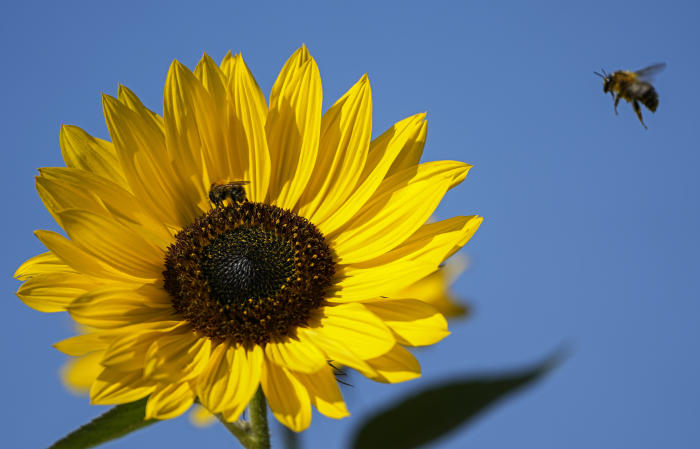
A bee forages on a sunflower in Gelsenkirchen, Germany, in September 2021. MARTIN MEISSNER/AP
Scientists often put a dollar figure on environmental degradation but health implications are often much more difficult to assess. A team led by Harvard University in the United States, however, has undertaken this difficult exercise with regard to the collapse of pollinating insects worldwide.
Published in December last year in the journal Environmental Health Perspectives, the results are striking. On a global scale, the lack of pollination of crops leading to less food production is said to be responsible for nearly half a million premature deaths per year. A figure that is probably underestimated, according to the authors.
They first assessed, region by region, the effects of falling populations of wild pollinators (bumblebees, hoverflies, butterflies, etc.) on agricultural production. “Their results indicate that 3% to 5% of fruit, vegetable and nut production is lost due to inadequate pollination,” said Josef Settele, with the Helmholtz Center for Environmental Research in Halle, Germany, who was not involved in this work.
These figures are “quite plausible and even rather low, given what we know about the importance of pollination,” Settele said. The German researcher, who co-chaired a global report of the United Nations’ Intergovernmental Platform on Biodiversity and Ecosystem Services (IPBES) welcomed “a very nice study which includes large amounts of data in a transparent model.”
The researchers then modeled the effect of this loss of production on prices, country by country, and the subsequent decrease in consumption of fruits and vegetables. Using the most consensual data from nutritional epidemiology, the authors were able to model the impact of the under-consumption of these products on mortality and came up with a number of some 427,000 deaths each year.
Read more Article réservé à nos abonnés Historic biodiversity agreement reached at Montreal COP15
Unevenly distributed impact
Yet, as Harvard’s lead author of the study Matthew Smith pointed out, the data used to estimate pollination failure were collected across five continents between 2010 and 2014. “Since then, most pressures causing wild pollinator losses have continued or worsened globally,” he said. “This suggests that insufficient wild pollination has an even greater effect on crop yield today than we estimated in our work.”
We are interested in your experience using the site.
Send feedback
Read more Article réservé à nos abonnés Isabella Tree on biodiversity: ‘We need a variety of species but also an abundance of life’
The impacts are unevenly distributed. “The loss of agricultural production is concentrated in low-income countries,” said Settele, “while the impacts on food consumption and mortality due to insufficient pollination are greater in middle and high-income countries where rates of diseases such as cancers, cardiovascular.. are higher.”
You have 23.1% of this article left to read. The rest is for subscribers only.

